
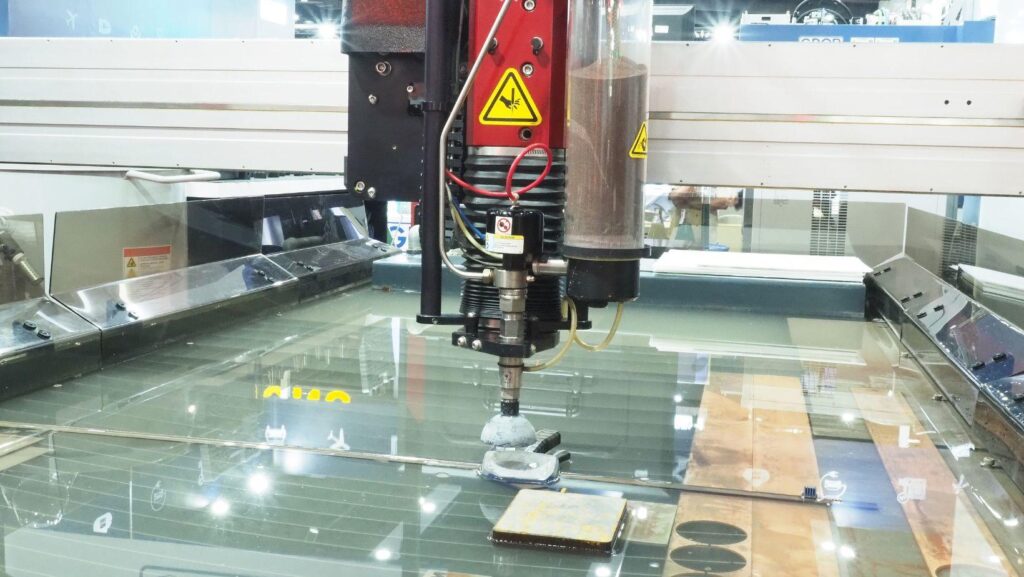
Choosing the right waterjet cutting machines for your business requires more than comparing machine prices or specifications. The right equipment needs to match the materials you work with, the thicknesses you regularly cut, your required accuracy, production volumes, workshop space, and the high-pressure pump required to achieve your target production output. Considering these factors before investing can help you select a machine that meets your current requirements while allowing room for future growth.
1. Consider the Materials You Need to Cut
Start by identifying the materials your business cuts most frequently. Waterjet cutting can be used across a wide range of materials, including metals, stone, glass, composites, and other materials that may be difficult to process using conventional cutting methods.
Consider both your current material requirements and the types of work you may take on in the future. If your business works with several different materials, a versatile machine may provide greater long-term value than equipment designed around a narrow range of applications.
Material thickness is also important. The machine and cutting configuration need to provide sufficient capacity for the thickest materials you expect to process.
2. Determine the Required Cutting Area
The size of your workpieces should influence the size of the cutting table you choose.
Before selecting a machine, consider:
● The maximum dimensions of the materials you normally process
● The size of your typical finished components
● How much material needs to be positioned on the cutting table
● The available floor space in your workshop
● Whether your production requirements are likely to increase
A larger cutting table can provide greater flexibility, but it also requires more floor space and may increase the overall investment. Choosing a size based on actual production requirements can help avoid paying for capacity you are unlikely to use.
3. Assess Your Required Cutting Accuracy
Different applications have different accuracy requirements. Components used for general fabrication may have different tolerances from parts manufactured for engineering, architectural, or precision applications.
When comparing machines, consider the accuracy offered by the cutting system, motion control, and cutting head. It is also worth considering how consistently the machine can achieve the required results over repeated production runs.
If your work involves intricate profiles, tight tolerances or complex shapes, prioritising precision and machine control can be particularly important.
4. Choose the Right Machine Configuration
Waterjet machines are available in different configurations, so consider the type of cutting your business actually needs.
For example, a standard 3-axis configuration may be suitable for many two-dimensional cutting applications. More advanced multi-axis configurations can provide additional flexibility for applications involving angled cuts or more complex geometries.
You should also consider features such as:
● CNC control systems
● Cutting head configuration
● Automatic height control
● Abrasive delivery systems
● Software compatibility
● Automated or semi-automated functions
The objective is not necessarily to choose the machine with the most features. Instead, select a configuration that supports your applications without adding unnecessary complexity or cost.
5. Consider Production Volume and Cutting Speed
Your expected production volume is another important consideration.
A machine used occasionally for prototypes or small production runs has different requirements from one operating for several hours each day. If production volumes are high, cutting speed, machine reliability, automation, and setup time can have a significant impact on overall productivity.
Think about how many parts you expect to produce, how frequently materials will need to be changed, and how much operator involvement will be required between jobs.
It can also be useful to consider future demand. If you expect production volumes to increase, selecting equipment with sufficient capacity may prevent the need for an early upgrade.
6. Select the Right High-Pressure Pump for Your Output
The required number of parts per hour or day should be one of the first considerations when selecting the high-pressure pump. The pump directly influences cutting speed, production output, operating costs, and overall machine dependability.
Different pump configurations and power levels can suit different production requirements.
30 Horsepower
A 30 horsepower pump can be suitable for general jobbing work across a broad range of materials and thicknesses, provided the resulting cutting speed meets the required production output.
For businesses handling varied jobs rather than continuous high-volume production, this level of pump power can provide a practical balance between cutting capability and operating requirements.
50 Horsepower
A 50 horsepower pump is worth considering when production requirements are higher and faster cutting rates can provide a meaningful productivity benefit.
As an indicative guide, cutting rates can improve by around 30% on many applications, although the actual improvement depends on the material, thickness, nozzle configuration, and other cutting parameters. The additional pump capacity should therefore be assessed against the number of parts you need to produce and the expected return from increased productivity.
87,000 PSI
For high-volume cutting, particularly when processing thick or hard plate, an 87,000 psi system may be worth considering. Higher pressure can improve cutting rates in suitable applications and may reduce abrasive consumption per part.
However, pressure should not be considered in isolation. The appropriate pump depends on the materials being processed, required production rate, cutting configuration, and overall operating costs.
Compare Pump Reliability and Service Requirements
Pump selection is also a long-term maintenance decision. Before purchasing, compare service intervals, service-part costs, and repair arrangements between different pump technologies.
Waterjet systems may use intensifier, direct-drive or electric servo pumps, each with different operating and maintenance characteristics. Ask how routine servicing is performed, which components are likely to require replacement, and how readily those parts can be sourced.
It is also important to establish whether major repairs can be completed onsite or whether the pump needs to be returned to a specialist facility. This can have a significant impact on potential downtime and production continuity.
For industrial production environments, intensifier pumps are a particularly dependable option, with established service procedures and readily available parts.
7. Calculate the Total Cost of Ownership
The purchase price is only one part of the overall cost of owning a waterjet machine.
Before making a decision, consider ongoing expenses such as:
● Abrasive consumption
● Water usage
● Electricity
● Pump servicing
● Replacement parts
● Consumable components
● Operator requirements
● Potential downtime
A machine with a lower initial price may not necessarily have the lowest operating cost over its working life. Comparing the expected running and maintenance requirements of different machines, including the high-pressure pump, can provide a more realistic view of the investment.
8. Check the CNC Software and Control System
The control system can have a major effect on how efficiently your team can operate the machine.
Look for software that supports your existing design and production workflow. CAD/CAM compatibility, nesting capabilities, and straightforward programming can help reduce preparation time and material waste.
An intuitive control system can also reduce the learning curve for operators, particularly if your business has several people who may need to use the machine.
When assessing software, consider not only its current capabilities but also whether it can support the types of jobs you expect to undertake in the future.
9. Consider Maintenance and Technical Support
A waterjet machine is a significant investment, so access to technical support should be part of the purchasing decision.
Ask potential suppliers about:
● Installation and commissioning
● Operator training
● Preventive maintenance
● Pump service intervals
● Service-part availability and costs
● Pump repair arrangements
● Availability of replacement components
● Troubleshooting support
● Warranty coverage
● Ongoing technical assistance
Downtime can affect production schedules and customer commitments. Understanding how quickly pumps and other critical components can be serviced or repaired is therefore an important consideration when comparing equipment and suppliers.
10. Match the Machine to Your Applications
The right machine should be selected around the work you actually intend to produce.
For example, a business primarily cutting thick materials may have different requirements from one producing intricate components from thinner sheet materials. Similarly, a business focused on high-volume production may place greater emphasis on pump capacity, cutting speed, and automation than a workshop producing occasional custom parts.
Create a list of your most common applications and identify the required:
● Material types
● Material thicknesses
● Workpiece sizes
● Cutting tolerances
● Production volumes
● Required parts per hour or day
● Edge quality
● Cutting speeds
You can then use these requirements to compare machine and pump specifications more objectively.
11. Consider Alternative Cutting Technologies
Waterjet is not automatically the right solution for every application. The most suitable cutting technology depends on the material, thickness, required finish, production volume, and overall project requirements.
For certain applications, laser cutting may offer advantages where high-speed processing of suitable sheet materials is a priority. Waterjet cutting, on the other hand, can be useful where a heat-free cutting process is important or where materials and thicknesses are less suited to thermal cutting methods.
Rather than choosing a technology based solely on its headline specifications, compare how each option performs against the requirements of your actual jobs.
Questions to Ask Before Buying a Waterjet Cutting Machine
Before committing to a machine, consider asking the supplier:
● What number of parts per hour or day can the machine realistically produce for my applications?
● Which high-pressure pump configuration and power level would support that output?
● What are the expected cutting rates for my materials and thicknesses?
● What materials and thicknesses is the machine designed to cut?
● What cutting accuracy can it consistently achieve?
● What cutting table size is available?
● What are the typical abrasive and operating costs?
● What are the pump service intervals and service-part costs?
● Which pump technology is being used: intensifier, direct-drive or electric servo?
● Can major pump repairs be completed onsite, or does the equipment need to be returned to a specialist facility?
● What maintenance is required?
● What training is provided?
● What technical support is available?
● Are replacement parts readily available?
● Can the machine accommodate future production requirements?
Having clear answers to these questions can make it easier to compare different machines and identify equipment that fits your production needs and expected output.
Final Thoughts
Choosing a waterjet cutting machine should be based on the specific requirements of your business rather than simply selecting the machine with the highest specifications. Material compatibility, cutting capacity, accuracy, production volume, required output, pump selection, operating costs, software, and after-sales support all need to be considered.
The high-pressure pump deserves particular attention because its power and design can directly affect cutting rates, abrasive consumption, production capacity, servicing requirements, and downtime. Comparing pump technologies, service intervals, parts costs and repair arrangements alongside the machine itself can help you make a more informed investment.
By defining your current applications, required production output and anticipated future requirements first, you can select equipment and pump capacity that are capable of supporting your production processes over the long term.